Happy 90th and 245th Anniversaries: Celebrating the Way We (Pretend We) Were
It is an odd coincidence that the Chinese Communist Party was founded only July 1, 1921, almost exactly 145 years from the day the United States of America declared their independence. In the same week, the China and the United States both commemorated the anniversaries of a few dozen male revolutionaries gathering under threat of execution for treason in order to agree to fight for the betterment of their nation. Obviously, these meetings took place in vastly different historical and cultural contexts, and so they naturally expressed starkly different ideas about what constitutes an ideal nation, but it is key to remember that both anniversaries commemorate good intentions that spawned nations, noble ideas that inevitably degenerate when constructed out of messy realities.

Many Western observers have been unnerved by the fervent nationalism expressed in the CCP’s 90th anniversary celebrations and the accompanying revival of “Red Songs,” propaganda classics that were all the rage in the Cultural Revolution of 1966-1976. But are millions of middle-aged Chinese singing about socialist revolution and resisting foreign imperialists any more indicative of resurgent Maoism and militarism than Americans singing Yankee Doodle or Battle Hymn of the Republic over the holiday weekend represent a secret plot to storm the white cliffs of Dover?
While I hate to perpetuate stereotypes, my experience in both the United States, China (and any known establishment offering karaoke) has confirmed that Chinese people love to sing. And those who came of age during the sixties and seventies in China grew up singing “Red Songs.” They know every word, and these songs form the soundtracks to the days of their youth, the equivalent of Classic Rock for baby boomers.
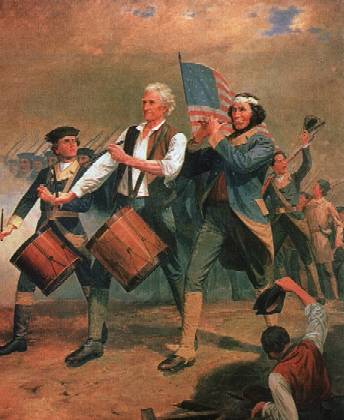 But it is difficult for some to understand why people would want to recall a youth that was typically spent parroting propaganda, performing self-criticisms, criticizing and abusing arbitrary victims, and/or laboring in the countryside. Of course, these and other skeletons in the CCP’s closet are as big a part of this week’s patriotic celebrations as American skeletons like Thomas Jefferson’s lovechildren, the near-extermination of Native Americans, WWII-era Japanese-American internment, and, of course, slavery. National holidays call for some degree of collective amnesia and creative rationalizing, so both Chinese and Americans generally prefer to look past their flawed human governors to celebrate the noble ideas they claim to protect. The right to publicly discuss, dissect and even invent skeletons in the vast closet of political travesties happens to be an ideal Americans hold sacred, but this is not necessarily the case in China.
 I overheard someone asking on the Fourth of July, “Doesn’t it feel great to be free?” But it is not as easy to imagine someone in China asking, “Doesn’t it feel great to be stable?" "Harmonious” fits a little better. “Prosperous,” maybe, for those who’ve been feeling the prosperity. Perhaps, “Free from foreign imperialism” is the best comparison and the closest to the party’s original rhetoric. But just as the Tea Party movement is appalled at how far the U.S. has strayed from Jeffersonian democracy, any orthodox Marxist would by aghast at today’s People’s Republic.
Perhaps the popular revival of Red Songs and Red Tourism (a new Red Classics Theme Park will open in Chongqing for next year’s CCP anniversary) indicates nostalgia for the days of economic equality and lifetime employment in light of the volatile markets and disparity in wealth in today’s China. Or maybe, it shows a popular longing for the sense of camaraderie and shared purpose that typified the mass rallies and mobilizing campaigns of high Maoism, in spite of the often-counterproductive end results. But it may be that the simple answer is what UCSD Prof. David Jordan claims people really mean when they talk about how much better things were in the good ol’ days: Things were better because they were young. It seems that this same longing for youth could apply on a national scale.
 The CCP and the United States both long for the days when they were small, revolutionary entities with high ideals and oppressive monarchies to struggle against. It is no coincidence that each nation commemorates a day on which the revolutionary leaders had yet to establish firm control over the entire country. Ideals are great when one is powerless to apply them.
 For whatever reason, it seems that citizens tend to long for a nation united in common cause and ideology. But large bodies of people are inevitably too fickle and troublesome to agree on where to get lunch, much less how to run a country. It seems that the only thing we all can agree on, optimist and pessimist alike, is that things could be better. And so we imagine our nations’ founding as this better time when we were led by noble paragons of virtue, united in common cause against faceless tyranny. Regardless of class, gender, or ethnicity, we were united in song, and everyone knew all the words. Although governments tend to support such mythmaking to various degrees, most reasonable individuals know that this time never existed, but we still know all the words, so why not sing along and let ourselves be carried back to a time when we were all naïve enough to believe?

Comments
Post a Comment